Thursday, August 7, 2008

Piper's View of Piety..."Should Produce a Passion for Social Justice and Practical Mercy "


Here's yet another reason why I love John Piper. Yesterday morning I clicked onto the blog "Desiring God" for my daily dose of John Piper. On this day, Piper summarizes one of his sermons from a few years back about what true piety should produce in us, that is "a passion for social justice and practical mercy." Preaching from Isaiah 58, he lists five needs that Isaiah and Jesus are passionately concerned about. (1) the need for freedom from bondage and oppression (2) the need for food (3) the need for housing (4) the need for clothing (5) the need for respect. The longer version of this sermon is even better, where he makes assertions such as "Piety that does not produce a passion for God-exalting social justice and practical mercy is worthless." and "I want to remind us as a church that we have been saved for the sake of God-exalting good works. We have been saved not merely to avoid evil, but to do good. Therefore the people of Christ should not be known primarily for what we don’t do, but what we do do."

Two months ago, I blogged here about a distorted piety being a fallacy that prevents today's evangelical churches from embracing its God-given responsibility to the poor. Since so many of these churches are children of the enlightenment (modernity) with their pie-in-the-sky dispensationalism, their church-growth/marketing pragmatism, their soul-saving dualism, their idol of consumerism, and of course their misplaced pietism, I've sort of wrote off the church in America (although my obedience to Christ and my calling has kept me within the church). Because Piper is such a towering, influential figure among fundamental and conservative evangelical pastors, maybe pietism in the evangelical church will begin to be restored to its proper place, which is producing a passion for social justice and practical mercy.

Wednesday, July 23, 2008

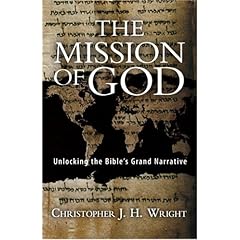
The best book on Mission Theology....


Yes, I am going to make a claim, which I know is purely subjective. C.H. Wright's magnum opus, The Mission of God: Unlocking the Bible's Grand Narrative, is by far the best, most comprehensive Mission Theology work that I have read to date. In my opinion, it supersedes such celebrated books on mission theology such as John Piper's "Let the Nations be Glad," David Bosch's "Transforming Mission," Lesslie Newbigin's "The Open Secret."

Don't get me wrong. These books by Piper, Bosch, and Newbigin are incredible masterpieces in their own right. I personally have been blessed by Piper's Doxology of Mission, Bosch's historical development of mission from the New Testament times to the post-modern, and Newbigin's emphasis on a Trinitarian nature of Mission. However, the breadth of C.H. Wright's narrative development of mission, from Genesis to Revelation, is simply amazing. Since Wright is also an O.T. Scholar (having written books such as "God's People in God's Land: Family, Land, and Property in the Old Testament," "Walking in the Ways of the Lord: The Ethical Authority of the Old Testament," "Old Testament Ethics for the People of God," "Knowing Jesus Through the Old Testament," ), he brings to light themes such as the Exodus, the call of Abraham, Year of Jubilee, the land, to show how the narrative missionally unfolds. Furthermore, his Biblical articulation of the relationship between evangelism and social action is the best that I have read and heard, even so that several from a group of fundamental-baptist (GARBC) pastors in their discussion of this book were compelled to admit that their previous thinking about mission was distorted and they were trying to figure out how their churches might embrace both evangelism and social responsibility (such as poverty issues). Yes, pigs are now flying in Grand Rapids!!!

One of these days, I may attempt to articulate a detailed review of this book, but for now, let me link you to several sites that I believe will wet your appetite to digest this book.

To hear an audio of Dr. Wright give a summary narrative of Mission of God and answer tough questions such as the relationship between evangelism and social responsibility within God's mission and God's sovereign purposes in judgment, listen here.

To follow Dr. Scot McKnight's Jesus Creed discussion on this book, click here, here, here, and here.

To read a excerpt from C.H. Wright that helps summarize what this book is about, including the missional nature of the Bible and a mission-centered theology of the cross, click here.

Sunday, July 6, 2008

Improving the Words of St. Francis


“Preach the gospel always. If necessary use words”. Urban legend has it that the source of this profound little saying was St. Francis of Assisi. Yet it finds a powerful affinity among younger evangelical twenty and thirty somethings in today’s culture. Quoted by younger adult Christians on facebook and Blogs everywhere, this quip is firmly entrenched in the worldview of an entire generation of American Christians. And understandably so. With such looming hostility towards Christians in general, many evangelicals under forty believe that the integrity of Jesus is at stake and therefore self-consciously have become “deed-based,” emphasizing social action duties such as feeding the homeless and building houses for the poor to counter this hostility.

This antagonism towards Christians has a political underpinning. Since media types and political commentators have wrongly generalized Christian evangelicals and fundamentalists as a religious right voting block intent on imposing a Christian Theocracy on the rest of the country, the same people have also confused aggressive evangelism as a recruiting tool for the evangelical’s political agenda.1 Yet I can understand their misjudgment. We Christians often make Jesus look like a politician who is running for office, dispersing pamphlets and literature, knocking on doors, and holding large rallies, all in the name of Jesus!

As a college student rebelling against my fundamentalist-Baptist upbringing, I had my fill of this type of evangelism, designed to mass-produce as many Christians as possible in the shortest amount of time. Something seemed terribly wrong with the methods that our spiritual forefathers taught us, including handing out tracts at restaurants to waiters and waitresses who didn’t want them and going door-to-door calling/witnessing to people who really had no desire to talk with strangers about their spiritual destiny. In addition, we were encouraged to bring as many people possible to Christian concerts and youth rallies where we heard passionate stories, designed to scare people into heaven-such as the heart-breaking account of a teenage girl who did not give her life to Christ in time, but instead died in a car wreck, which sent her to hell. “Today is the day of Salvation,” the evangelist would cry out. Next, scores of teenagers, manipulatively fraught with fear, rushed down the aisles to make sure they were going to heaven when they died. They had promoted a packaged, fire insurance for the future life as the essence of the Christian faith. Just as bothersome were the gospel presentations that I was taught. Romans Road, Four Spiritual Laws, the EE questions, and many others did not do justice for the gospel that I was slowly rediscovering. Rather these presentations reduced the gospel to a set of dry propositions that only seemed to pay lip service to the greatest story ever told.2

Fast forward twenty years later and I wonder if we’ve swung the pendulum to the other side. In lieu of past damaging misconduct by the Jerry Falwell’s, the Pat Robertson’s, and the James Dobson’s in the public square, it appears as if younger generations of Christians have self-consciously gagged themselves from speaking the name of Jesus in public. For instance, lets examine Rob Bell’s public interaction in a panel discussion at the “Seeds of Compassion” interfaith conference this past April. While Rob Bell displayed authenticity combined with his immaculate story-telling ability, he purposely avoided using the J word in a faith environment where Jesus is not a dirty word to the vast majority of people. Even as the Muslim scholar referred to teachings of the Koran and the Sikh holy man cited ancient Hindu wisdom, Rob Bell’s moving story about why we should forgive climaxed with, “Because it is the right thing to do!” Although a very true statement, the forgiveness that Jesus offers (which allows us to forgive each other and even forgive our enemies) is so much more than the shallow moralism that Rob alludes to in the discussion, which even most atheists could claim. As a result, the generic genuineness of Rob Bell’s interfaith dialogue did little to enhance the reputation and uniqueness of Jesus Christ. When I brought up these arguments on the blogosphere, almost every one who defended Rob did so based on not wanting to offend those who had written off Christianity because of the negative reputation of its followers.

Considering this situation as well as many other conversations with my fellow Christians, I am beginning to believe that my generation and younger have developed a shame complex of their fellow Christian brothers and sisters and have lost confidence in the word of God, the living (Jesus) but especially the written (the Bible). Maybe this is why we so readily embrace the supposed words of St. Francis “Preach the gospel always, if necessary use words” as our modus operandi of mission? Whatever the reason, its time we get back to using our words to proclaim the gospel along side of our actions. Just as there is something terribly wrong with a gospel that only proclaims words, there is also something inherently wrong with the “Preach the gospel, if necessary use words” way of thinking. It presupposes that proclamation is just an option of the gospel, whereas Romans 10:14 pictures the apostle Paul passionately posing the question “how can they hear without someone preaching to them?” Even as the gospel travels through relationships (as opposed to impersonal methods such as door-to-door witnessing, handing out tracts, and manipulating people at concerts and rallies), the gospel must be communicated through our words so that people can respond with repentance and faith in Jesus Christ.

So I have a proposal that will make this statement from St. Francis more in line with the Biblical narrative. Lets replace the “if” with “when.” Then it will state, “Preach the gospel always. When necessary, use words.” By substituting “when” with “if,” suddenly our words are no longer just an option, but a significant aspect of our gospel witness. Moreover, lets not forget that our radical sacrificial love of the poor and needy as well as our holy living (Read James 1:27) will distinguish us from so called Christians whose actions give credence to the stereotype of a loud-mouthed bigoted fundamentalist-evangelical. Therefore, with the power of the Holy Spirit, we can ungag ourselves and then tell the gospel story with confidence and clarity as an obedient response to God’s grace.

____________________________________
1To get a feel for the roots of fundamentalists and evangelicals, read George M. Marsdent's Understanding Fundamentalism and Evangelicalism (Grand Rapids: Eerdmans Publishing Co, 1991). By explaining their socio-religious history in the 19th and 20th centuries, one can understand why there is a tendency by fundamentalists and evangelicals to attempt to turn back the American social clock to the previous generation. This is their primary reason for engaging in the social aspects of politics, not to build a Christian Theocracy as many contemporary, paranoid political writers would have everyone believe.
2This statement does not mean that I am against propositional statements. Throughout all of scripture, its narrative makes propositional declarations. One example is found in the first statement of Genesis. "In the beginning God created the heavens and the earth." Since about 78% of the entire cannon is narrative, shouldn't we Christians attempt to master the art of story telling, especially the gospel?

Saturday, June 14, 2008

Fundamental/Evangelical Fallicies Part 2: Pietism


Keeping with the “isms,” the second fallacy that keeps the evangelical church from embracing their God-given responsibility to the poor is Pietism. This may seem unlikely, since aspects of pietism within the church of America during the 19th century actually inspired Christians to serve the poor and take on injustices such as slavery. Nevertheless, in the 20th century, when the diabolical twins of modernity-reason and science, were at the zenith of their dominance within Western civilization, the American church responded by adding some traditional dispensationalism (which cares little for the social world of today) and some platonic dualism (which treats the physical world as separate and subordinate to the spiritual) to their piety. Before we identify pietism's potential poison of today, let us explore a little of the historical context of this religious phenomenon.

The roots of Pietism go all the way back to seventeenth century Germany when certain church leaders such as Philipp Jakob Spener and August Hermann Francke, tired of cold, stifling, faith of the Lutheran church, began to emphasize pietistic activities such as Bible study, prayer, and religious experiences as a way of reigniting a passion for Jesus Christ. For the next couple hundred years, pietism spread throughout Europe and America, influencing a variety of the protestant groups such as the Mennonites, Moravians, Brethren, Covenant, Puritans, and Methodism.

Fast forward to the early twenty-first century, pietism in its most popular form, mutated into a Purpose-Driven-Life formula, emphasizing five purposes that drives a Christian. According to best-selling author and pastor, Rick Warren, our five purposes in life are worship, fellowship, discipleship, ministry, and mission. Regrettably, Warren did not look to Genesis 1 and 2 to discover who we are as humans and what purposes God assigned the first humans as a foundation to PDL. He might have discovered the multi-dimensions of imago Dei and the creation mandates given to God’s image bearers. Maybe Warren would have viewed this earth as more than a “dress rehearsal” for heaven, which provides very little motivation to help the poor here and now. Maybe Warren would have realized earlier our God-given responsibility to the poor, which finds its roots in the cultural mandate. Even with its emphasis on fellowship, this form of pietism leads to an individualistic, otherworldly gospel that divorces loving God from loving our neighbor.

For instance, growing up in several fundamentalist-Baptist churches, my spiritual formation revolved around piety activities such as studying, reading, and memorizing the Bible, praying, fellowshipping, and evangelism. Never once was I ever encouraged to reach out to the poor. Never once did our youth group ever serve at a soup kitchen or homeless shelter, nor did I hear anything taught from the Bible that mentioned the Christian’s responsibility to help the poor. Yes, I understand that today’s fundamental and evangelical churches do try to include a service project to a soup kitchen now and then and maybe a short-term mission trip that reminds them of how blessed they are here in America. But by in large, the pietistic practices of prayer (including all-night prayer meetings), singing praise and worship songs in church or at Passion worship events, Bible study, revivals, and evangelism that takes place today are not inextricably practiced together with sacrificially loving the poor and oppressed. Hence, the body of Christ appears to be primarily a mouth without any legs and arms.

Thankfully, in the case of Rick Warren a trip to Johannesburg, South Africa caused him to rethink his purposes. After visiting some of the shantytowns and connecting with churches that were housing widows and orphans from AIDS victims, Warren began to reexamine the scriptures in light of the poor and oppressed. “I found 2000 verses on the poor. How did I miss that? I went to Bible college, two seminaries, and I got a doctorate. How did I miss God’s compassion for the poor? I was not seeing all of God’s purposes.” Now am I holding up Rick Warren as the prototype example for evangelicals to follow? No and Yes. I prefer that he communicate a more robust gospel, taking the foundation of creation more seriously (read Wittmer’s Heaven is a Place on Earth) and calling more attention to the devastating consequences of the fall and our depravity as humans (read C. Plantiga’s Not the Way it’s Supposed to be). This leads to a larger view of redemption (including people and all creation), with a response of repentance and belief in Christ (rather than Warren’s “whispering a prayer that will change your life” of “receiving and believing”). Why do I even mention Warren’s view of the gospel? Since he is on the front-lines attempting to equip an army of Christians from all over the world to help solve global poverty and hunger, a PDL surface view of sin, depravity, and evil will never get at the root causes of poverty. Without addressing complex structural systems of evil as well as the deep-seated sin within the hearts everyone, including the poor, the oppressed, and the oppressors, all of our efforts to make a dent in the battle against global hunger and poverty amounts to be as Ballington Booth once said, like trying to “bail the ocean with a thimble.”

Nevertheless, we also need to commend what Rick Warren is doing as well. For instance, by putting the majority of his millions that he made from the sales of Purpose-Driven-Life into charitable foundations that address global poverty and hunger issues, he is living out the apostle Peter’s command to “Live such good lives among the pagans that, though they accuse you of doing wrong, they may see your good deeds and glorify God on the day he visits us.” Our pagan culture is taking notice, having a difficult time arguing against all of the good that Rick Warren and Saddleback church are doing for the poor and oppressed. This can only lead to enhancing the reputation of Jesus Christ. 21st century piety is a mixed bag, but can overcome its faults by embracing a full-bodied gospel of creation, fall, redemption, and restoration which can only lead to the Lordship of Christ in every aspect and arena of our lives. May our sacrificial service to the poor and oppressed also compel non-Christians to pronounce, "Soli Deo Gloria!"

Wednesday, May 28, 2008

Poster Boy for Grand Rapids Theological Seminary

Can you believe it? The seminary that almost dismissed me for bad grades and taking too long to complete my degree (it took me 14 years) has me on their web page. You can find it here. Actually, I feel really good associating myself with GRTS. They are in the process of developing an urban ministry emphasis with their intercultural studies program, tapping into two very highly reputable and qualified teachers (from urban Grand Rapids) in Dr. Rik Stevenson from City Hope Ministries and Reggie Smith from Roosevelt Park CRC. Their knowledge and experience of doing ministry in the 'hood is second to none.

Moreover, GRTS is putting their money where their mouth is. They are offering a 32 hour tuition free Masters degree in Ministry leadership to inner-city pastors/ministry practitioners with 4 or more years of full time inner-city ministry experience (12 at a time, cohort style). In the past, I've heard people complain and even make snide remarks about the lack of theological competence among inner-city pastors (think of all the storefront ministries in urban communities that come and go). However, there are many of us inner-city ministry practitioners who fight tooth and nail to raise funds not only to take care of our family needs, but also to help with needs in the community. Therefore, attending seminary is not even on the radar screen. I know if I had this opportunity ten years ago, it would have relieved much of our family's financial stress over the past several years while I paid about 2000 a year to take one seminary class per semester. I believe this program could go a long way in helping mature ministries in urban Grand Rapids and throughout the Midwest. Thank you GRTS for tangibly modeling to other schools what it means "to act justly and to love mercy."

Monday, May 12, 2008

A Tribute to Paul Gordon


Paul Gordon, chairman of Gordon Food Service and a personal friend of Urban Transformation Ministries, died last Tuesday. You can read all about his legacy here. Over the past twelve years, he was such an encouragement to both Sherilyn and me. He was one of my favorite people at Berean and his humility, generosity, joy, and friendliness was contagious to be around….

I remember one time while running one of our inner-city youth programs, running into him while he was dropping off some books at the church. At the time, I was in the process of dealing with a student who had just threatened the life of another kid in our programs as well as threatening me. Once the youth left the church, Paul asked me a couple questions, put his arm around me, and encouraged me in my ministry.

For many years, he anonymously gave to missions locally and globally, providing the resources to many different mission initiatives. I remember having a conversation several years ago where he took the entire Gordon family (several generations) to Africa and for two weeks they spent their Christmas serving impoverished people with Aids. As I read more and more from people all over the world, that was a normal occurrence. His motto was, "We are here to expand God's Kingdom!" Thank you so much for helping us at Urban Transformation Ministries expand God's Kingdom in the 'hood!

Monday, May 5, 2008

Fundamental/Evangelical fallacies (that prevent churches from truly embracing ministry to the poor) Part 1


My last post, Uneasy Consciousness, was actually a prologue to a series that I’ve been thinking about for some time. At first, I was going to name this series “top ten excuses as to why fundamental and conservative churches do not make the poor a priority. But it sounded too wordy and seemed too shallow. However, since most of these churches are children of the enlightenment, I will attempt to expose some fallacies of modernity that still linger among the fundamentalist and conservative evangelical churches. Regrettably, these fallacies prevent them from fully embracing their God-given responsibility to help the poor and needy. At the same time, I must resist the temptation of painting these churches with a broad-brush stroke. Surprisingly, I am finding more and more of these churches seeking ways to live out the 2000 verses in the Bible that speak of God’s heart for the poor and needy. For instance, I’ve witnessed genuine conversations unfold among fundamental church leaders and pastors on internet forums such as Sharper Iron as they discuss and debate what their church’s responsibility should be to the poor. This has been a source of encouragement to me. Even so, I can honestly say as an insider that the fallacies I name are in fact keeping many of these churches from embracing ministry among the poor as part of their mission.

My first fallacy has been everybody’s whipping boy, dispensationalism, which grieves me because this theological construct does contain some points to consider. In recent days, however, dispensationalism has been linked to just about every fault and blemish that fundamentalists and evangelicals possess, which I believe is unfair. But like most things, dispensationalism is comprised of the good, bad and ugly. For those who are not familiar with the term, dispensationalism refers to an understanding of the Bible that divides the relationship of God to humanity throughout redemptive history in sharply separated epochs. What separates them from the rest of Christendom boils down to two things: their literalness when interpreting the Bible and their sharp distinction between Old Testament Israel and the New Testament Church. Although the theological construct of dispensationalism has only been around for less than two-hundred years of the church’s two-thousand year history, it really took hold among fundamental and conservative evangelical churches within America during the first half of the twentieth century. Much to the surprise and even the chagrin of many of my non-fundamental-evangelical friends, I still hold to a form of dispensationalism, albeit a very broad and progressive one (one of these days, I’ll post why I still see myself within the dispensationalist camp-although on the edge).

However, dispensationalism in its more traditional, historic form has deceived its followers into believing that certain passages of scripture do not really apply to our current dispensational time period. For instance, according to traditional dispensationalists, the “least of these” within the Sheep and Goats judgment passage of Mathew are Jews who experience persecution during the seven-year future tribulation. Therefore, they disregard this vivid picture of final judgment as relevant to their lives because they interpret the story to be about judgment of nations treating persecuted Jews rather than how the current church must treat the “least of these,” right here and right now. The same goes for kingdom living in the Sermon on the Mount. In their view, due to the Jewish rejection of Christ as their Messiah, Jesus postponed His kingdom rule of the Jews until his future millennial reign. Therefore, the ethical demands of the Sermon on the Mount for these dispensationalists represent how God’s people will live under Christ’s rule during his future, literal 1000 year reign on earth (so if this is true, will God allow face-slapping while reigning “with a rod of iron” since we are told to turn the other cheek?)rather than how God's people should live in the here and now. Hence, these scriptures have no bearing on how we are to live today. The same even goes for the Old Testament prophets that pronounced judgment against those who withheld justice for the poor. I could go on and on, but I think you get the picture.

Proponents of this view defend dispensationalism by declaring that their interpretation springs from a literal, grammatical, historical hermeneutic of the entire Bible. Yet could it be that their rigid commitment to this type of hermeneutic created a system of interpretation that depends way too much on modernity’s twin nemesis of rationalism and science? Isn’t it ironic that in their desire to stay faithful to Scripture through a rigid adherence to its hermeneutic may in fact have led them to the edge of theological liberalism? Just as Modernity’s rationalism and darwinistic science influenced many North American mainline churches to embrace liberalism by denying certain doctrines of the faith, has Modernity’s rationalism and Baconian scientific method led certain dispensationalists to render large portions of the Bible meaningless due to their unswervingly rigid embrace of an interpretative method? What is the difference between a person who denies the validity of certain scriptures like Thomas Jefferson who cut and pasted the parts of the Bible that he disagreed with and a dispensationalist that fails to acknowledge the present application of large portions of scripture because he places its primary meaning and application into a future dispensation of time? I’ll let you figure out that question.

What's more, the outworkings of this dispensational hermeneutic has led to an imbalanced view of God’s kingdom, centering most of its attention on a future kingdom with little emphasis on the present. While a person’s entrance into the Kingdom of God receives attention, its ethical responsibilities are minimized. While future events of the escaton dominate its worldview, present kingdom activities are questioned. In addition, with its emphasis on the sharp discontinuity between Old Testament Israel and the New Testament Church, dispensationalism presents a truncated social ethic, especially in regards to its view of the church’s role helping the poor and oppressed. Their interpretation allows them to make excuses for not helping the poor such as, “Why rearrange the deck chairs on the Titanic?” “Since this world is going to hell in a hand basket, shouldn’t we primarily focus on what’s really important, which is evangelism?” “Doesn’t focusing on the needs of the poor take away resources for missions and church planting?” “I don’t see any New Testament mandate for alleviating poverty, therefore, why even bother?” Believe me, I've heard them all and debated each and every one of them.

On the other hand, when Christians are not so rigid in their literal, historical, grammatical interpretation of the Bible, but rather take in account the diversity of literary genres that comprise scripture such as narrative, law, poetry, prophesy, parabolic, and apocalyptic, suddenly the kingdom of God (present and future) is brought back into a more balanced “already, but not yet.” When Christians emphasize the unity of the entire cannon, especially with more continuity between Israel and the church rather than making a sharp distinction between the two, the church understands its mission to include more than just evangelism. It incorporates both the good news of the gospel and good works, both the cultural mandate and the redemptive mandate, as they bring the Lordship of Jesus Christ into every arena of life.

This post may be a hard pill to swallow for some of my dispensational friends, but I feel that I must question their theology just as much as I've questioned the sacramental theology of the poor embraced by Shane Claiborne. Have fun unpacking this post!!!